Your Team's Hidden Superpower? Their Weekend Hobbies.
The same initiative can play out differently in different companies: make employee interests visible so people can find each other across departments, and the rollout may either become useful or disappear. The tool and the policy are only part of the work. The rollout determines whether anyone knows what to do with the information.
The useful question is how to make interest-based connection stick after the announcement. The practical work is a short sequence of decisions about visibility, participation, and how the first groups are formed.
Start With What You Can See
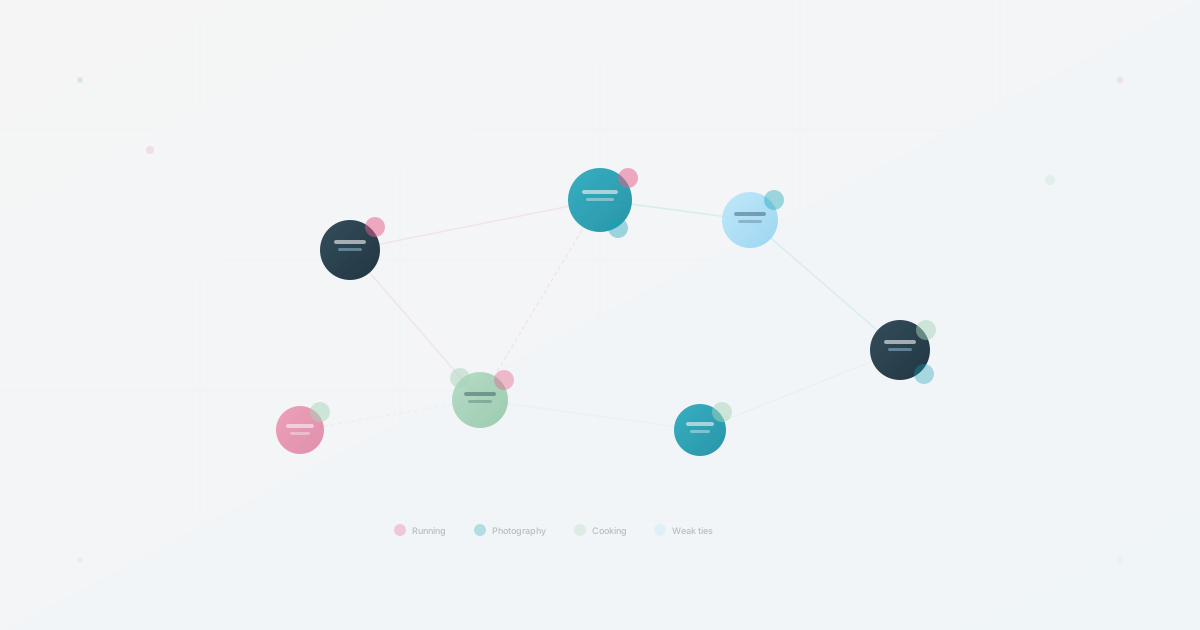
Teams often already have informal interest groups. A few runners who train together. A Slack channel for cooking. A cluster of board game people who eat lunch together on Fridays.
But these groups are invisible to the rest of the organization. They form through proximity, which means they are usually people from the same team or the same floor. They do not cross department lines.
That matters because cross-department trust can be harder to build. People within the same team already share context, attend the same meetings, and have reasons to talk daily. A shared interest can offer one low-pressure entry point for people who have no professional reason to interact, but it is not a substitute for clear ownership or good management.
The companion article explains the product rationale for including interests in profiles. A field alone does not show whether people will browse or use the information, so getting to that point requires more than adding it.
Why a Company-Wide Email Can Stall
A company-wide message might say: “We’ve added an optional interests field to your profile. Use it only if you want colleagues to know this context.”
The message may be ignored. People may not be against the idea, but it can sound like homework if it does not answer the question every employee silently asks: “What happens after I fill this in?”
Start with a small group from different departments. A visible sponsor can help, but nobody needs to perform enthusiasm for the program. When the announcement goes out, there should already be something to look at and one clear example of how a colleague can use it. A hypothetical profile might mention making hot sauce, trail running, or competitive Scrabble. Label examples as examples, and never populate profiles with personal information without the person’s choice.
This can change the framing. People are not just filling in a blank form. They can see a possible use for the information before choosing whether to share it.
Seeding Groups That Cross Boundaries
One practical detail is worth testing: the first participants in an interest-based group can shape its trajectory.
If you start a #running channel and the first people in it are all from engineering, others may read it as an engineering channel and move on. Inviting a few early participants from different departments can make the channel feel more company-wide from day one.
Creating channels alone is not enough. Invite specific people from different teams and give the first group a visible mix of interests. Once the company is larger than a few teams, keep the information somewhere people can browse and search.
When these groups work, a possible benefit is easier routing across teams. For example, someone in Sales may notice a shared interest with an engineer while looking for technical input and feel more comfortable starting a conversation. Measure the actual time and quality of the answer instead of promising a particular turnaround.
Where It Gets Messy
Some things do not work easily, and pretending otherwise would waste your time.
Some people will not participate. They consider their personal interests private, or they do not want to be “the fun one” at a company where they feel the culture does not support it. That should be fine. Making the field mandatory can produce low-quality answers and resentment. Keep it optional. A smaller voluntary fill rate is more useful than a complete field full of answers people supplied only because they felt pressured.
Some groups will fizzle. The book club that meets twice and then dies. The photography channel that goes quiet after a month. This is normal. You do not need every group to survive. Look for evidence that a few voluntary connections help people reach across team boundaries. A shared interest may make a later conversation easier, but do not promise a lasting relationship or a measurable business outcome without tracking it.
Some managers will see this as a distraction. “We don’t need a cooking channel. We need people to hit their deadlines.” That objection is fair. Interest groups do not replace clear goals or good management. They create a little trust underneath the formal workflows that slow down employees who cannot find one another across departments.
Onboarding Is the Best Moment for This
Buddy programs usually pair new hires with someone from the same team, which makes sense for logistics. The relationship that helps a new hire feel at home can be elsewhere: someone in a different part of the company who happens to share an interest.
A new hire who loves photography might be matched with someone in a different department who also shoots on weekends. Their first conversation may have an easy topic beyond the expense report process. Onboarding is about belonging as well as information transfer.
Cross-department buddy matching based on interests is one tactic worth testing. It is easier to administer when interest data is visible, searchable, and voluntary, but the matching still needs checks for reporting lines, workload, time zones, and consent.
Three Decisions That Predict Whether It Sticks
Three decisions are worth testing when you introduce interest-based connection. They affect whether people understand the purpose and feel safe choosing whether to participate.
Leadership can make the choice visible. If a CEO, VP, or department head shares an interest voluntarily, employees can see that the field is safe to leave blank and useful to complete. It is a signal, not a guarantee of adoption.
The data is visible, not locked away. Interest surveys that end up in a spreadsheet on someone’s drive are hard to use. The information needs to live where people already look, such as employee profiles in the tools they use every day. If someone cannot search “who else likes bouldering” across the intended audience, the data is effectively hard to find.
Nobody is forced. The completion rate on an optional field is only one signal. Pair it with evidence that people used the information for an introduction or a useful connection. If people do not want to share, mandating the field will not fix the underlying problem.
Interest-based connection is a small intervention. It will not fix a broken culture or replace good management. In a distributed or hybrid team, it is one low-cost experiment to test alongside the remote-team culture pilot, clear ownership, useful onboarding, and respectful communication norms.
Use this today
Seed one interest group across three teams
Leave the exercise with a small, opt-in test of cross-team connection.
- 01
Invite volunteers from three departments to add one interest they are comfortable sharing. Explain who can see it and how it will be used.
- 02
Choose a specific shared activity and invite the first three people deliberately, rather than waiting for a channel to fill itself.
- 03
Give the group one easy next action, such as a short introduction thread or a recurring coffee. Keep the commitment small.
- 04
After two weeks, ask who made a new cross-team contact and whether the connection changed how they found help.
Pass / fail check
Keep the experiment optional and judge it by useful conversations, not by the number of hobbies collected.
Questions readers ask most